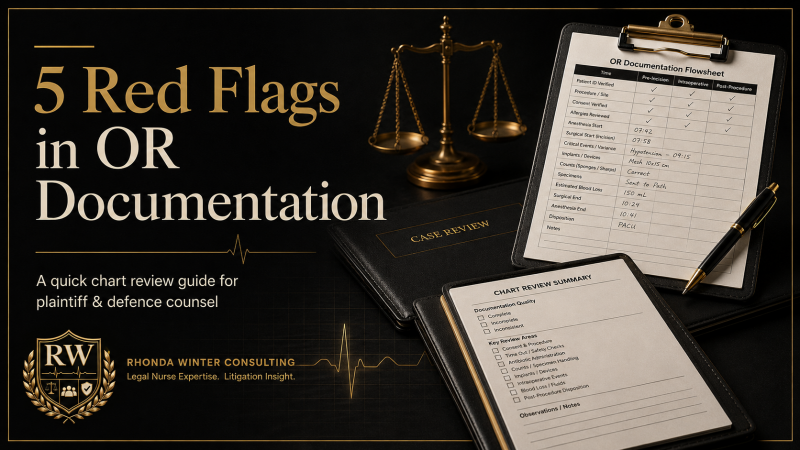
Operating room records are dense, fast-paced, and built around checkboxes, flowsheets, and counts rather than narrative charting. That's not a reflection of careless nursing, it's a reflection of the pace of the room. But it does mean these records reward a closer look before a case theory gets built on top of them.
After more than 25 years working in the OR, PACU, and surgical suite leadership, and reviewing medical records from the legal side since 2008, I find myself returning to the same handful of red flags.
None of these findings automatically establishes negligence or determines the outcome of a case. But each one deserves a closer look.
1. Incomplete Surgical Safety Checklist Documentation
The checklist has three distinct phases, briefing (before anaesthesia induction), time out (before the first incision), and debriefing (before the patient leaves the OR). Each phase needs its own timestamp, not one blanket completion note for the whole thing.
Why it matters: CMPA's own review of closed medical-legal cases found checklist-related deficiencies contributing to wrong-site surgeries, retained items, and other serious incidents, and found the resulting care indefensible in nearly all of them. When a phase is missing, undocumented, or timestamped identically to another, that's not a charting shortcut. It's evidence the checklist may not have functioned the way it's meant to.
2. Tourniquet Details Not Documented
When a tourniquet is used, the record should show site/location, and both inflation and deflation times.
Why it matters: Tourniquet time is directly tied to nerve injury and compartment risk. CMPA's review specifically flagged a case where the site was correctly marked and a formal time out was called, but the team still prepped and placed the tourniquet on the wrong side. Missing or incomplete tourniquet timing is one of the clearest gaps to catch early in a positioning or nerve injury claim.
3. Fluid Management Not Reconciled: Fluid In/Out, EBL, and Irrigation
Fluid balance is bigger than estimated blood loss (EBL) alone. It's fluid in, fluid out, blood loss, and, in certain procedures using irrigation, the volume of irrigation fluid instilled versus recovered.
In gynecologic procedures that use fluid to distend the uterus, hysteroscopic myomectomy and endometrial ablation in particular, excess absorption of irrigation fluid into the bloodstream can cause dilutional hyponatremia and cerebral edema, a recognized and serious complication. The same scrutiny applies to tumescent fluid in liposuction, where volume infiltrated, volume aspirated, and lidocaine dose all carry their own risk of fluid overload and local anesthetic systemic toxicity (LAST).
Why it matters: EBL should match what anesthesia has independently documented and be confirmed as part of the debriefing phase, not an afterthought charted separately by whoever remembers to fill it in. When irrigation or tumescent volumes aren't tracked and reconciled at intervals, that's not a minor omission. It's the absence of the exact safeguard meant to catch a serious complication before it happens.
4. Surgical Count Discrepancy Without the Correct Resolution Protocol
A sponge, small items, or instrument count that comes back incorrect should trigger a defined protocol: recount, manual wound and cavity sweep, and intraoperative imaging if it still doesn't reconcile before closure.
Why it matters: CMPA's review found retained surgical items tied directly to counts not being documented, a second count not being performed prior to closure, or an incorrect count not prompting an X-ray despite a lengthy or complicated case. A correction with no documented cause is not resolution, it's a gap.
5. Patient Safety Mechanisms Not Charted
Safety strap placement, padding at bony prominences, location of the electrosurgical grounding pad, and placement of the BP cuff and ECG electrodes should all be documented as part of routine OR nursing care. The record should also show the area prepped and the type of prep solution used, including the agent, concentration, and whether it was alcohol-based.
Why it matters: When these are absent from the record, it doesn't just look incomplete, it removes the evidence that positioning-related and burn-related injury prevention measures were actually taken. These are exactly the details that matter when a case involves a nerve injury, pressure injury, or an unexplained burn. Solution used for skin prep agents carry a real risk of chemical burn when the wrong solution reaches the wrong site, alcohol-based prep near the face and eyes being the clearest example. Without the site and the solution charted, there is no way to establish what was applied where, and a burn found post-operatively has no documented explanation.
Before You Commit to a Theory of the Case
These are five patterns I look for when reviewing OR documentation.
But a red flag is exactly that: a reason to look deeper, not a conclusion.
Whether a finding develops into a meaningful standard-of-care issue depends on the facility's protocols, the applicable standards at the time, the chronology of events, and the complete clinical picture.
That distinction matters whether I am reviewing a case for plaintiff or defence counsel.
As a Legal Nurse Consultant, my role is to help take a complex surgical record and make the clinical story clearer: identifying what happened, when it happened, what the documentation supports, what may be missing, and where further investigation may be warranted.
Because sometimes the most important part of an OR record isn't a dramatic entry.
It's the timestamp that's missing, the count that was quietly corrected, or the fluid deficit nobody reconciled.
Rhonda Winter, RN, CLNC
Legal Nurse Consultant | Rhonda Winter Consulting
Reference: Canadian Medical Protective Association. Surgical Safety Checklists: A Review of Medical-Legal Data. Ottawa (ON): CMPA; 2016 May.