

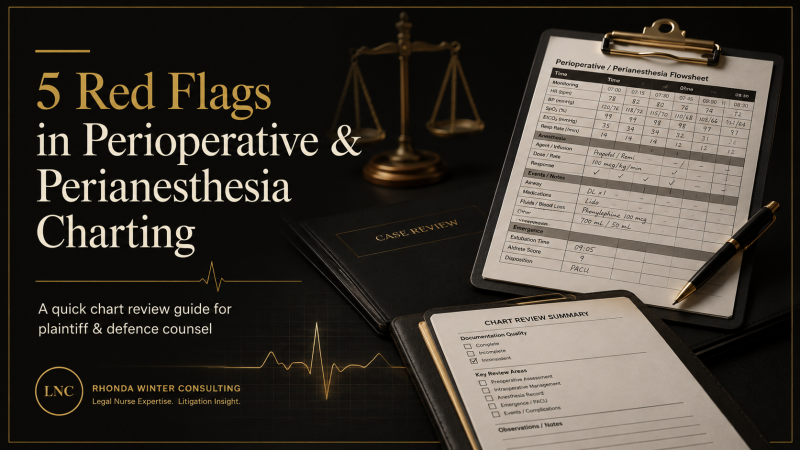
What plaintiff and defence counsel should look for when the medical record doesn't tell a straightforward story
Perioperative and PeriAnesthesia records are dense, fast-moving, and easy to misread if you don't know what “normal” looks like on the unit.
After more than 25 years working in PACU, the OR, and surgical suite leadership, and reviewing medical records from the legal side since 2008, I find myself returning to the same handful of red flags.
None of these findings automatically establishes negligence or determines the outcome of a case. But each one deserves a closer look.
1. Vital Sign Gaps During a Documented “Stable” Period
A patient is described as stable, yet there is a 20- to 45-minute gap in documented vital signs.
In early PACU recovery or during a sedation procedure, that gap can be significant, particularly if it occurs during the same period in which a complication appears to have developed.
Why it matters: Monitoring frequency is generally established by applicable standards and facility expectations. When the record contains a gap, it may be difficult to determine whether deterioration occurred suddenly or simply wasn't documented as it developed.
2. Discharge Criteria Charted as Met Without the Supporting Values
A discharge or transfer note states that the patient met criteria, but the underlying documentation doesn't clearly support that conclusion.
The record may be missing an Aldrete score, pain rating, required assessment, or other information expected before discharge or transfer.
Why it matters: “Met discharge criteria” is a conclusion. The supporting clinical information is what allows the reviewer to determine whether that conclusion is supported by the record.
3. Handoff Communication Doesn't Match the Receiving Unit's First Entry
Compare the OR-to-PACU or PACU-to-ward handoff with the receiving nurse's first assessment.
Differences in reported pain level, airway status, level of consciousness, or other clinical findings can reveal where important information may have been lost or changed during transition of care.
Why it matters: A discrepancy between what was reportedly communicated and what was documented immediately afterward can help identify where the clinical story begins to diverge.
4. Delay Between an Abnormal Finding and Physician Notification
Timing matters.
Compare the timestamp of an abnormal vital sign or assessment finding with the documentation showing when the physician or anesthesiologist was notified.
Then consider that interval in the context of the facility's escalation policy and the patient's overall clinical condition.
Why it matters: This can become one of the most consequential areas in a medical record because it allows the reviewer to construct a clear timeline: What happened? When was it recognized? When was it escalated? What happened next?
5. Consent Documentation Doesn't Reflect What Was Actually Done
Compare the consented procedure or anesthesia plan with the operative and anesthesia records documenting what actually occurred.
Differences involving the procedure, site, extent of treatment, or sedation level deserve closer examination.
Why it matters: A discrepancy involving consent is more than a documentation inconsistency. It raises the question of whether the documented consent corresponds with what was actually performed.
Before You Commit to a Theory of the Case
These are five patterns I look for when reviewing perioperative and perianesthesia medical records.
But a red flag is exactly that: a reason to look deeper, not a conclusion.
Whether a finding develops into a meaningful standard-of-care issue depends on the specific unit's policies, the applicable standards at the time, the chronology of events, and the complete clinical picture.
That distinction matters whether I am reviewing a case for plaintiff or defence counsel.
As a Legal Nurse Consultant, my role is to help take a complex medical record and make the clinical story clearer: identifying what happened, when it happened, what the documentation supports, what may be missing, and where further investigation may be warranted.
Because sometimes the most important part of a medical record isn't a dramatic entry.
It's the inconsistency, the missing piece, or the timeline that doesn't quite fit.
Rhonda Winter, RN, CLNC
Legal Nurse Consultant | Rhonda Winter Consulting